History and The Binhamy Manor and the Trust
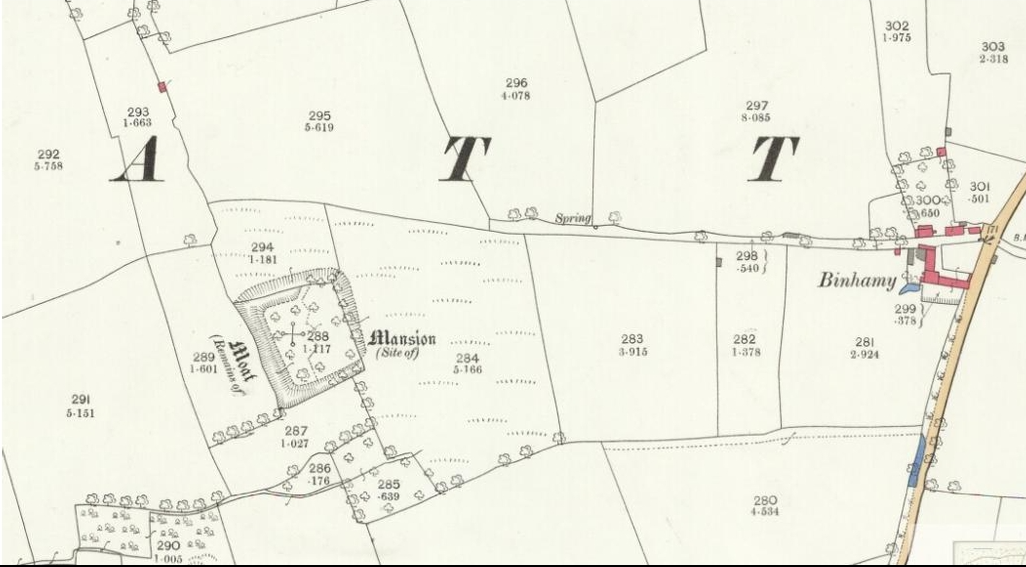
‘Binhamy Castle’ is a moated manor house which dates at least to the early 14th century. It was owned by Ralph de Blanchminster, Lord of the Manor of Stratton.
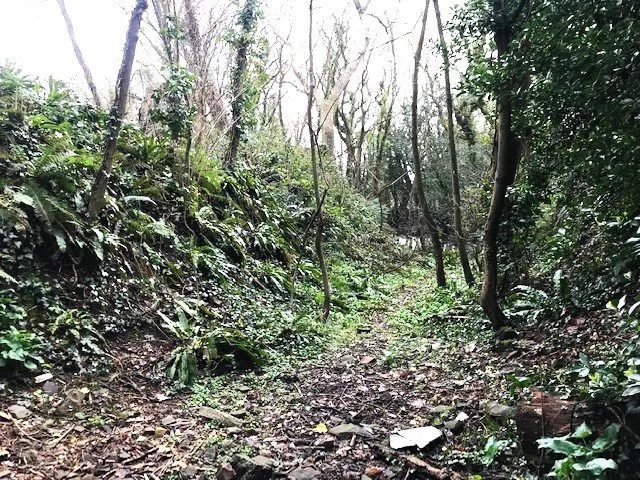
The site today consists of an area of 0.3ha defined by a mostly dry moat which is about 10m wide at the top but varies in depth. The deepest section is on the west side.
The moat has a partial inner bank, and there are outer banks on three sides.
The interior contains mounds, hollows and some fragmentary walling.
Not surprisingly, it has many owners throughout its history, and this is shown on this site. It was described as the Seat of Sir J Colshill by William Worcester and the ‘Ruyned aunient seate of the Grenviles’ by Norden c.1600.
The map shows details of the site in 1883.
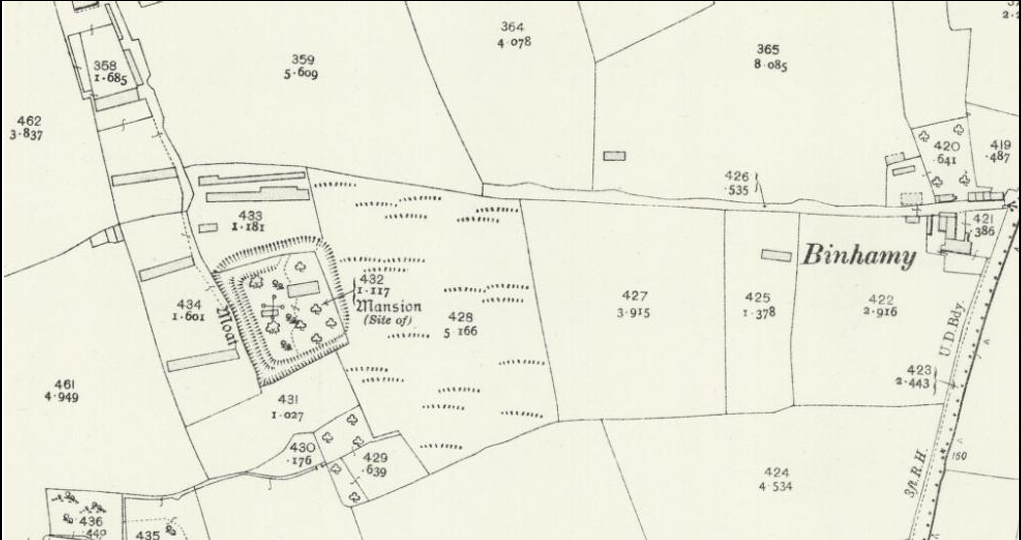
By 1933 the site had been out of functional use for centuries. But at this time there was some temporary building within the moated area. This is belived to be a chicken house!
At some point in the recent past, the moated site fell within land owned by a Mr Cleave- hence the Cleavelands name for the approach road. It then came into the possession of a Mr Shobrooke in the early 1950’s. The site itself would eventually be included in Binhamy farm which was then in the possession of the Beswetherick family and it was Andrew Beswetherick who instigated proceedings that has resulted in the formation of a Trust to protect the site.
Formation of the Trust
As mentioned above it was Mr Andrew Beswetherick who, in 2017, requested a Conservation Management Plan to be undertaken for the preservation of the site and this was undertaken by South West Archaeology Ltd (SWARCH) and was completed 9th March 2017.
The idea was to create a Trust for the site and the report created by SWARCH would help, inform and guide Trustees in its task of managing the site for the future and for the community. Essentially, the Trust was entrusted to preserve the site from damage, by misuse, and vegetation overgrowth. The report also gave advice to the Trust as to how it could engage local schools, special interest groups and the general public by drawing attention its history. The report also identified potential ongoing issues following the completion of planned house building to the north and east of the site; the issue centred around improved access to the site.
Importantly, it should be appreciated that the moated site is a Scheduled Monument, that is that it is protected by law. So, any work done on the site must be with close liaison with Historic England representatives, particularly to obtain consent for any work carried out on the monument.
The SWARCH report pointed out that the Trust, when formed, should take account of the fact that the condition of the site is ‘generally unsatisfactory with major localised problems’. They highlighted, for concern the woodland and scrub vegetation covering the site which has the potential to cause damage to both the surface building remains and below ground archaeological remains.
The present Trustees appreciate this point and work is being undertaken to make the site safe, as there are a number of trees that are damaged by disease, and these are being cut down. The ground area within the moat is very uneven and overgrown with vegetation, which does present a level of danger to the public. Some of this undergrowth is also being considered for removal especially as this includes rubbish brought into the site, which includes wood with exposed nails.
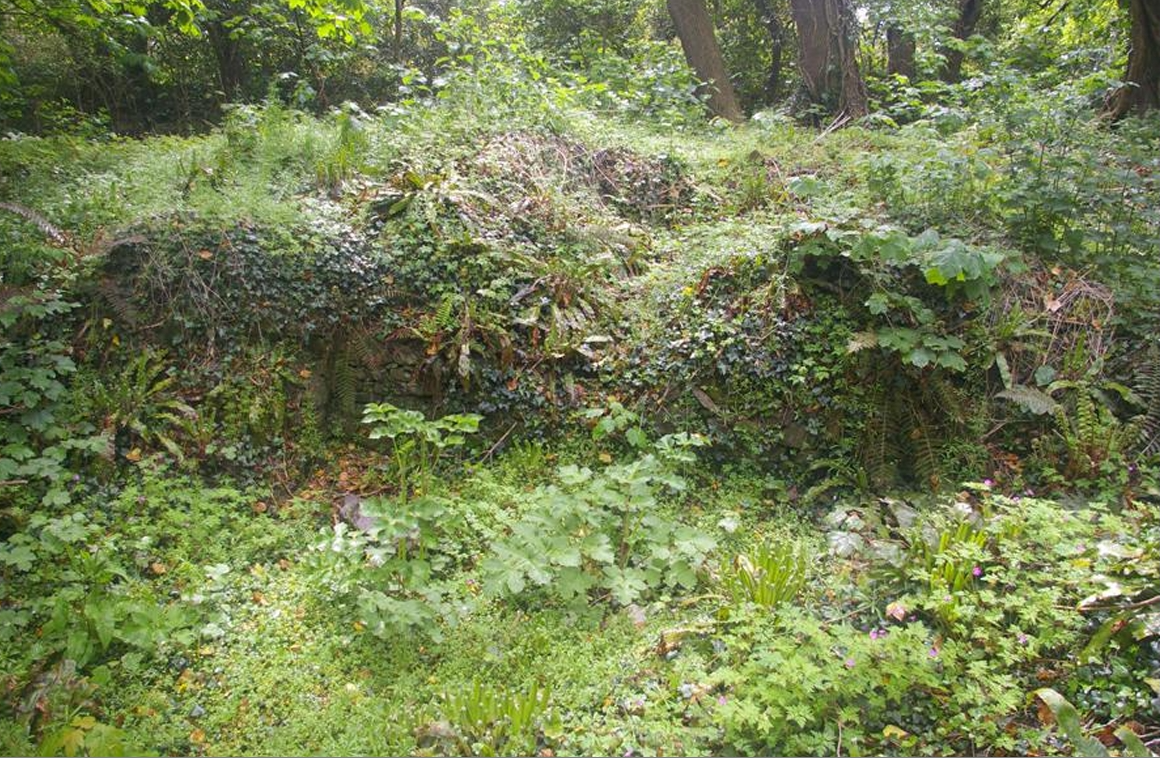
The picture shows the irregular nature of the ground inside of the moat and the vegetation taking hold.
S
E
W
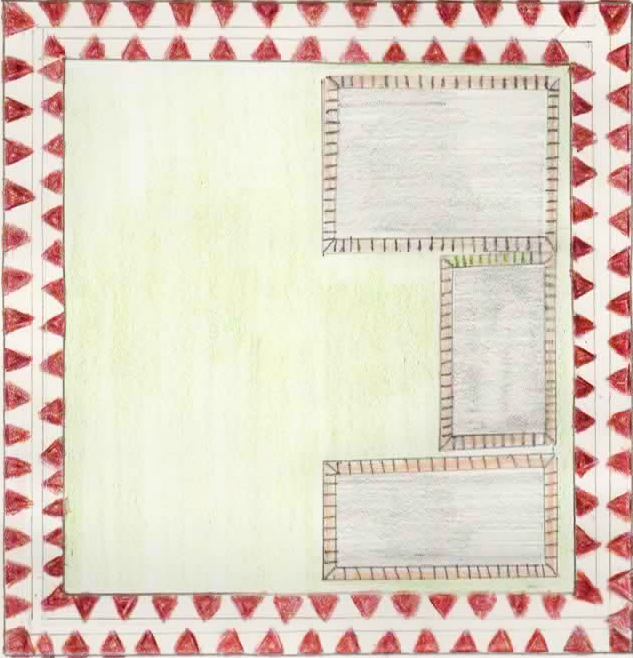
In 2015 Malcolm Wright conducted a geophysical study to find evidence of trace structures below soil level, in part to substantiate the observations of Colonel Wrey L’Ans in the 19th century who, incidentally, drew an outline of old foundations from which the attached image is drawn.
The geophysical study of 2015 did not fully corroborate the earlier observations but it is probably correct to say that buried under the soil, brambles and rubble will be at least some of the foundations of the manor house built by Ralph de Blanchminster in the 13th or 14th century.
N
The Trust presently consists of eight Trustees, and they are now responding to the need to inform the public of the importance of this site to our local heritage.
This website is intended to convey some of this story, recognising that there is still much to be discovered. Also, in progress is a public notice board which will draw attention to the site. Discussions relating to safe and convenient access to the site is also under review and this website will provide a means to keep the public advised of developments.
More generally, an archaeological study was carried out before recent house building began and details of findings are discussed on this website. However, the SWARCH report also suggested that one aim for the Trust in the future could be to investigate features to the south of the site, carried out in conjunction with the local community (subject to landowner consent.) It is obvious that this Medieval Manor will have had some activity or features immediately to its south leading down to the Neet estuary; this land is presently covered in scrub and this could be a consideration for the future.
The photo shows the moat itself, which is dramatic in its size and fortunately has been left undisturbed despite the ravages of time. Although there is some growth within the moat, as can be seen, it is generally in a good state for its age.