Binhamy Ownership
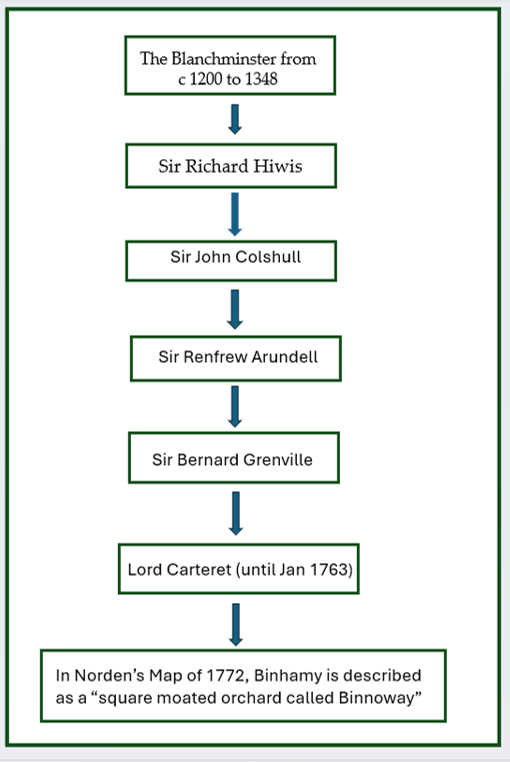
During the Norman period wealthy families started to come to live in our area, attracted by the lure of King Arthur and the comparative wealth of this region. In the mid-thirteenth century the Blanchminster family came to Stratton and eventually set up home at Binhamy. Clearly this was a special place to the family as they chose to call their new home Bien Amie which can mean well loved.
Binhamy is often dated to around 1335. However, the Blanchminster ownership of Binhamy probably started around the early 1200’s and ended around 1348; this is discussed further below.
The Blanchminster story starts with the marriage of William Fitz Ralph de Albo Monestario (Blanchminster) to Lucy Turet in 1198. They initially lived at the Blanchminster or Turet estates in Shropshire. However, before long they move to the Stratton area. They may not have set up home at Binhamy at that time, perhaps first living at the castle at Week St Mary.
In fact, their son Sir Ranulph marries Isabella* de Wyke (of Week St Mary), whose family also owned an estate on the Isles of Scilly. Their son Sir Reginald de Blanchminster is said to have been born at Binhamy, and he married Lady Robin around 1260. The couple had a son, Sir Ranulph de Blanchminster and he married Isabel de Aspel; they had three daughters. In 1306 he is identified as the owner of the castle at the Isles of Scilly, however, this castle became the possession of the Dutchy in 1337. Sir Ranulph then sought the King Edward’s permission to crenelated his manor at Binhamy in 1335. He died in 23rd June, 1348.
Coheiress Alice Blanchminster married Sir Richard Hiwis (Hewis) of Chagford, Devon. And Binhamy now becomes an Hiwis Estate. The daughter Emma or Emmeline marries Sir Robert Tresilian. However, he got himself into very deep water during the Peasant Revolt of 1381. When Chief Justice Sir John Cavendish was killed during the Revolt, Sir Robert Tresilian was appointed to take over the position and was put in charge of punishing the rebels, which he did so harshly that he built up a lot of enemies.
On 17 November 1387, Tresilian was among a number of royal loyalists who were charged with treason by the group of noblemen known as the Lords Appellant.
When Tresilian's case came up for trial, he had gone into hiding and could not be found, and was sentenced in absentia. On 19 February 1388, he was discovered hiding in a sanctuary in Westminster. He was dragged into court with cries of 'we have him' from the mob and, as he was already convicted, was summarily executed, being hanged naked before his throat was cut.
His widow Emma then married Sir John Colshull (or Coleshill) who was a Cornwall MP. Binhamy now became a Colshull estate. Their daughter Joan married Sir Renfrew Arundell, and this was the start of the long Arundell ownership.
Notes: Apparently, there was a claim on Blanchminster estates by Thomas Neville of Rolleston in 1486; he being the great-grandson of Cecilia Blanchminster. However, this claim did not change the transfer of ownership, but it is a subject that will be explored in the future.
There is also the possibility that ownership of Binhamy came to the Acland family. Margaret Acland married the 2nd Baron Arundell in 1675; she died in 1691. As there were no heirs from the marriage of the 4th Baron Arundell, who married Elizabeth Wentworth, the the Arundell estates transferred to the Aclands; the 4th Baron died in 1768. It is possible that the Arundell estates included land at Binhamy, if not the actual property.
The history of the Isles of Scilly records that the islands “belonged to Davers and Whittington, as representatives of that branch of the Arundells, which inherited the estates of the Coleshills and Blanchminsters”.
Sir Bernard Grenville eventually becomes owner at Binhamy, and this is followed by his descendant Lord Carteret who died 2nd January 1763.
Camden’s map published in 1777 describes the site as a square moated orchard called Binnoway.
*There is further intrigue concerning Lady Isabella, wife of Sir Ranulph. Sir Ranulph de Blanchminster may have had an unhappy marriage; because of this, he may have chosen to take part in the Crusades, rather than endure his unhappy marriage. Other accounts say that his conscience dictated that he should become involved. Whatever the motivation, his wife Isabella agreed a pact with Sir Ranulph that she would remain faithful to him for three years, after which she would assume he had been killed in battle. It is possible that she did not wait three years but married John Allet, who was keeper of the Blanchminster castle on the Isles of Scilly. John Allet was hardly a nice man and dealt with miscreants very harshly; he is said to have left them on the Bishop Rock to die of starvation!